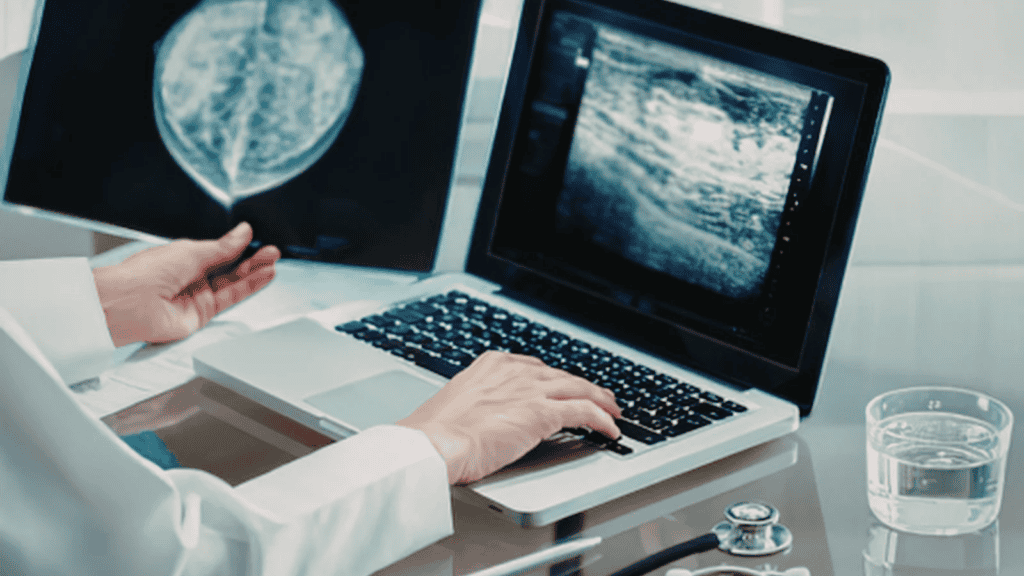
You’ve just had your annual mammogram, and the results came back abnormal. Your stomach may drop as worry and anxiety set in, but try not to jump to the worst conclusion. An abnormal mammogram does not automatically mean you have breast cancer. In fact, most people who are called back after a screening mammogram do not ultimately have cancer.
An abnormal result simply means that your healthcare team saw something that needs a closer look. The next step may be additional imaging, follow-up monitoring, or, in some cases, a biopsy. Understanding what may happen next can make the process feel a little less overwhelming.
What Happens After an Abnormal Mammogram?
Your next steps depend on what the radiologist saw on your screening mammogram. You may be asked to return for additional images or another type of breast imaging.
Your healthcare provider may recommend one or more of the following:
Diagnostic mammogram
A diagnostic mammogram takes additional X-ray images of the breast, often from different angles, to examine an area more closely. This is different from a screening mammogram, which is designed to look for potential problems in people without breast symptoms.
Breast ultrasound
A breast ultrasound uses sound waves to create images of the breast. It can help healthcare providers determine whether a lump or other finding is fluid-filled, such as a cyst, or solid. Ultrasound may be used along with a diagnostic mammogram to get a better look at an area of concern.
Breast MRI
A breast MRI uses magnets and radio waves to create detailed images of the breast. MRI is not routinely used as the next step for every abnormal mammogram. It may be recommended in certain situations, including for some people who have a higher risk of breast cancer.
Additional follow-up imaging
Not every abnormal finding requires a biopsy. Depending on what the radiologist sees, you may be asked to return for another mammogram or other imaging after a period of time to make sure an area has not changed. Your mammogram report should explain what follow-up is recommended and when you should have it.
When Is a Breast Biopsy Recommended?
If additional imaging shows an area that needs a closer look, your healthcare provider may recommend a breast biopsy.
A biopsy removes a small amount of breast tissue so it can be examined under a microscope for cancer cells. A biopsy is the only way to know for sure whether an abnormal area is cancer.
Most people who undergo a biopsy do not receive a breast cancer diagnosis.
There are several types of breast biopsies, and the type recommended for you depends on what was found, where it is located, how suspicious it appears, and other factors.
What to Expect During a Breast Biopsy
Core needle biopsy
A core needle biopsy uses a hollow needle to remove several small samples of breast tissue. The procedure is often guided by ultrasound, mammography, or another imaging method so the provider can accurately sample the area of concern. Core needle biopsy is commonly used when breast cancer is suspected.
Surgical biopsy
In some cases, a surgeon may recommend removing part or all of an abnormal area through a surgical biopsy. An incisional biopsy removes part of the abnormal area, while an excisional biopsy removes the entire abnormal area, sometimes along with a small amount of surrounding tissue. Surgical biopsies are used less often than needle biopsies.
After the biopsy, a pathologist examines the tissue under a microscope. Your healthcare provider will explain when you can expect your results and what they mean for your next steps.
What Happens If a Biopsy Shows Breast Cancer?
If your biopsy shows breast cancer, your next step may be a consultation with a breast surgeon or another breast cancer specialist. Your care team will look at the type and stage of the cancer, the location and size of the tumor, your overall health, and other factors when developing a treatment plan.
For many people with breast cancer, surgery is part of treatment. Two of the most common surgical options are Lumpectomy/Partial Mastectomy and Total Mastectomy.
Lumpectomy/Partial Mastectomy
A Lumpectomy/Partial Mastectomy, also called breast-conserving surgery, removes the cancer along with a small amount of surrounding healthy tissue while leaving most of the breast in place. This can be an option for many people with early-stage breast cancer, although it is not appropriate for everyone. The size and location of the tumor, the size of the breast, the number of areas affected, previous treatments, and other factors can influence whether Lumpectomy/Partial Mastectomy is recommended.
Total Mastectomy
A Total Mastectomy removes the entire breast. There are several types of Total Mastectomy, and the amount of skin, breast tissue, nipple, and areola removed can vary depending on the procedure and the individual patient’s situation. A Total Mastectomy may involve one breast or both breasts.
For some people with early-stage breast cancer, both Lumpectomy/Partial Mastectomy and Total Mastectomy may be options. Your breast surgeon can explain the differences, including potential benefits, risks, recovery, and whether additional treatment, such as radiation, may be recommended.
Patients receiving breast cancer surgery may also be candidates for Oncoplastic Reduction Surgery or Breast Reconstruction. Your Breast Surgeon and Plastic Surgeon will determine which procedure is most appropriate for your cancer diagnosis.
What Questions Should You Ask Your Breast Surgeon?
Receiving a breast cancer diagnosis can make it difficult to know what to ask next. Bringing a written list of questions to your appointment can help you feel more prepared.
Consider asking:
- What type of breast cancer do I have?
- What stage is my cancer?
- What treatment options are available to me?
- Am I a candidate for breast-conserving surgery?
- Why are you recommending one type of surgery over another?
- Will I need radiation, chemotherapy, hormone therapy, or another treatment?
- What should I expect during recovery?
- Will I need additional imaging or surgery?
- Are there other specialists I should see as part of my care team?
You may also want to bring a family member or friend to your appointment. Having another person there can provide emotional support and give you another set of ears to help remember what your care team says.
Take the Next Step, One Appointment at a Time
An abnormal mammogram can be scary, but it does not mean you have cancer. In many cases, additional imaging shows that a finding is benign or simply needs to be monitored. If a biopsy is recommended, remember that a biopsy is a diagnostic step, not a cancer diagnosis.
The most important thing you can do is follow up on the recommendation in your mammogram report. Ask questions, keep your appointments, and give yourself permission to take the process one step at a time.
For mammography services, diagnostic breast imaging, and breast surgery, The Baton Rouge Clinic offers care to help patients navigate the next steps after an abnormal breast screening result. Learn more about mammography services and breast surgery, or request an appointment online.